
Lesson · 4 min Steady
Drawing It Out
In one line A quick drawing can show you that a confident guess is wrong.
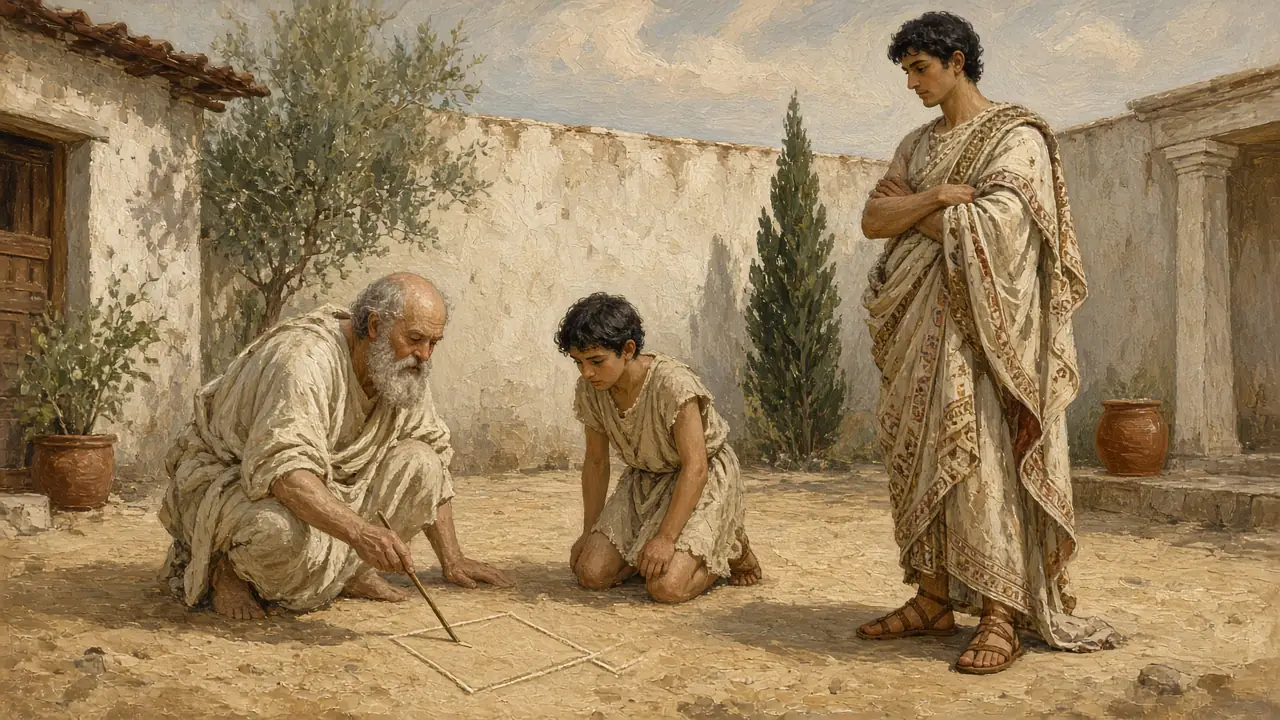
In Plato’s Meno, Socrates asks an enslaved boy in Meno’s household, who has never been taught geometry, to double the area of a square. The boy confidently says to double the side. Socrates does not correct him. He draws the square in the sand and lets the boy see the result.
The drawing shows a square four times as large, not twice. The boy sees his own error, and he is puzzled for the first time. From there, with more drawing, he finds that the side of the doubled square is the diagonal of the first.
Plato used the scene to argue that learning is a kind of remembering. The lesson here is a smaller, practical one. A sketch makes hidden assumptions visible, and seeing a mistake for yourself teaches more than being told. When you feel sure of a claim, try to draw it.
The doubled square

Ida is asked to cut a garden bed’s area in half. She says, “Just make each side half as long,” and feels sure.
She sketches a 4 by 4 bed and then a 2 by 2 one. The small one is a quarter of the area, not half. She redraws with sides about 2.8 long and gets close to half.
Try this today Take one claim you feel sure of and sketch it on paper; note what the drawing shows.
Cite or share this lesson
A plain reference you can paste into notes or an essay:
Quest2Reason. “Drawing It Out.” https://quest2reason.com/learn/lesson/drawing-it-out. Accessed 14 November 2026.
Sources
- Plato, Meno — Socrates draws squares and leads an enslaved boy to see his own mistake; Plato’s argument that learning is recollection.