
Lesson · 4 min Stretch
No Inner Theater
In one line Dennett argued there is no inner theater where experience is shown, and the hard problem may be a trick of introspection.
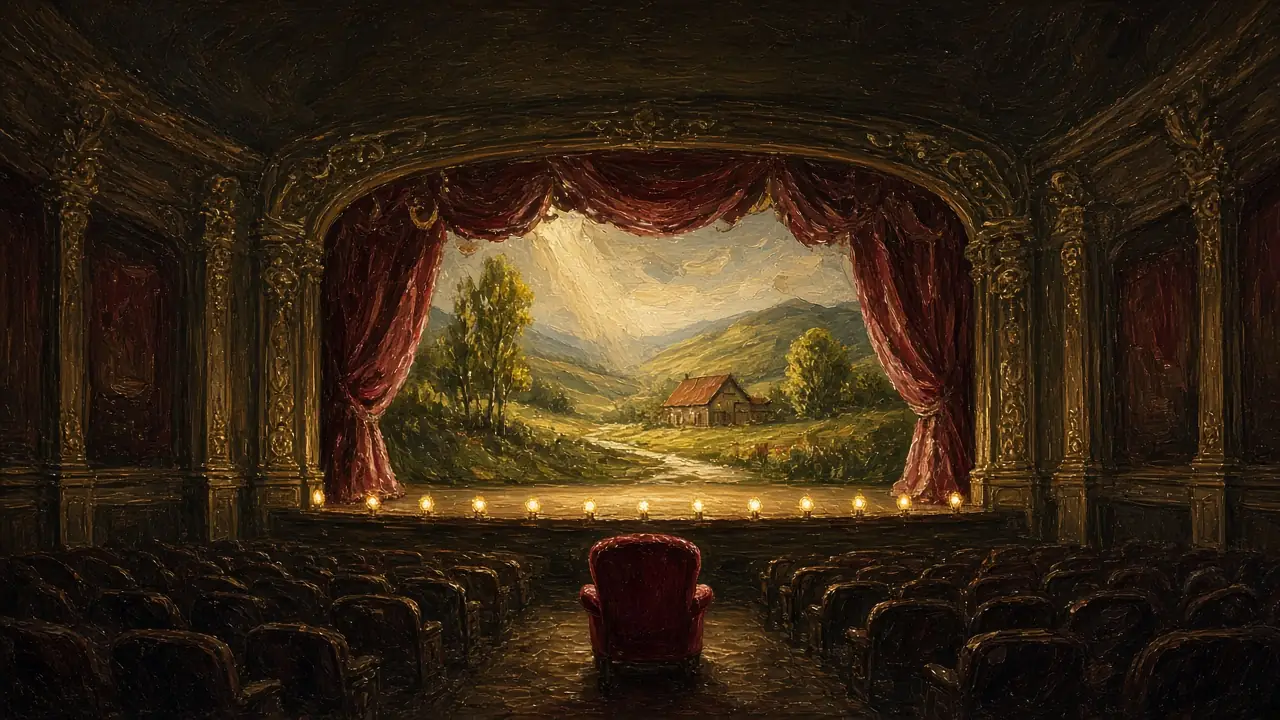
Daniel Dennett, in Consciousness Explained from 1991, rejected the picture he called the Cartesian theater: the idea that somewhere in the brain there is a place where everything comes together and is shown to an inner viewer. There is no such place, he argued, and no viewer.
Instead, his multiple drafts model says the brain runs many parallel processes, editing and revising interpretations, and none of them is the final, official version. What we call consciousness is what wins influence over memory, speech and action.
Dennett thought the hard problem rests on an illusion: we are sure our experience has special inner qualities because that is how our brains represent themselves to us. Illusionists such as Keith Frankish follow him. Critics reply that an illusion of experience would itself be an experience.
Go deeper
Dennett proposed heterophenomenology: taking people’s reports about their experience seriously as data, while staying neutral on whether the reports are accurate. Experiments on change blindness, where people miss large changes in a scene, suggest our sense of a rich, detailed visual world outruns what we take in. Dennett died in 2024, and the debate he carried on with Chalmers continues.
The missing detail

Priya is sure she has a complete picture of her friend’s living room. In a game, her friend swaps a lamp and a painting while she glances away. Priya does not notice.
She had felt she was seeing everything at once. Dennett would say the feeling of a full inner picture was itself a report the brain made, not a picture on a screen. What she experiences may be less than it seems to her.
Try this today Describe your experience of this room in detail. Then ask which parts you observed and which you assumed.
Cite or share this lesson
A plain reference you can paste into notes or an essay:
Quest2Reason. “No Inner Theater.” https://quest2reason.com/learn/lesson/no-inner-theater. Accessed 13 November 2026.
Sources
- Daniel Dennett and Marcel Kinsbourne, “Time and the Observer” (Behavioral and Brain Sciences, 1992) — The Cartesian theater, a place where it all comes together for an inner viewer, against the multiple drafts model of parallel, continuously revised contents. Paraphrased; nothing is quoted.
- Keith Frankish, “Illusionism as a Theory of Consciousness” (Journal of Consciousness Studies, 2016) — The view that our sense of special inner qualities is a misrepresentation, so the hard problem becomes the illusion problem. The abstract is free; the article is not.
- Stanford Encyclopedia of Philosophy, “Consciousness”, section 9.4 — Dennett’s multiple drafts model among the narrative interpretative theories, and his rejection of the Cartesian theater.
- Wikipedia, “Consciousness Explained” — Summarizes Dennett’s 1991 book and its reception.
- Wikipedia, “Illusionism (consciousness)” — Covers Dennett, Frankish and the objection that an illusion is itself experienced.