
Lesson · 4 min Steady
The Stronger Argument
In one line Learning to argue both sides is a strength, until persuasion stops asking what is true.
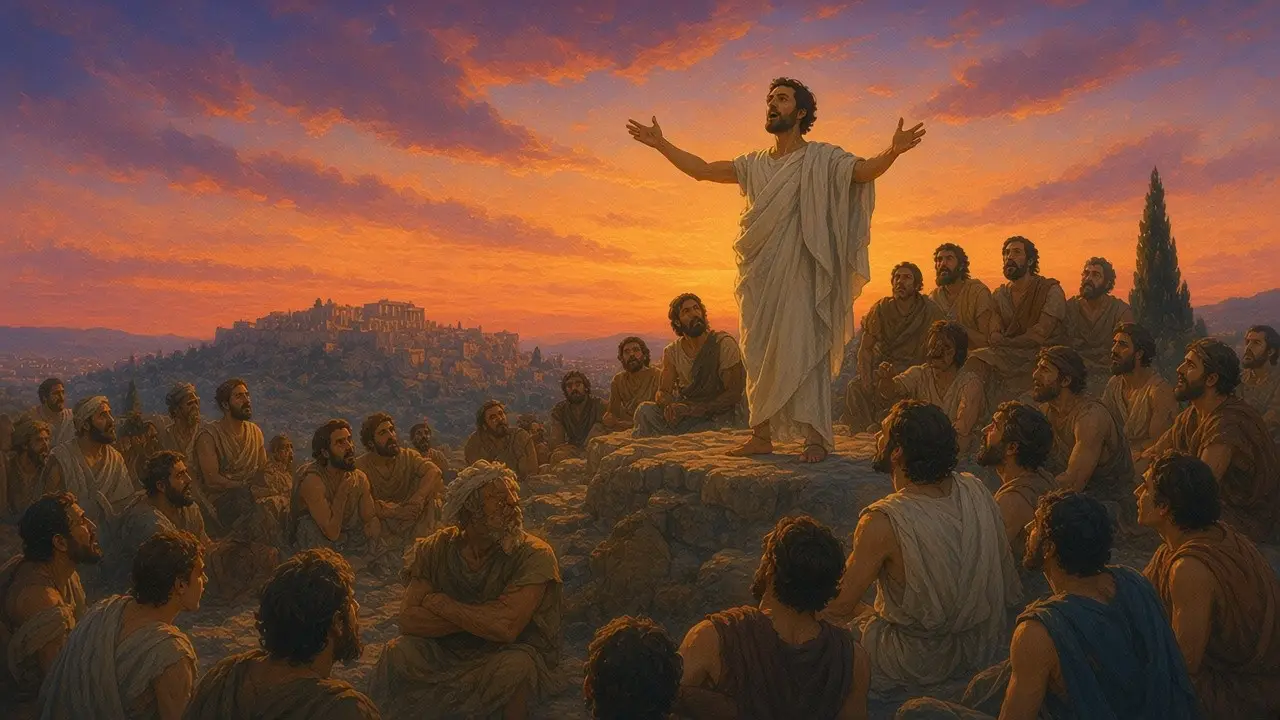
The Sophists taught that there are two arguments on every question, and they trained students to make both. Protagoras was said to promise that he could make the weaker argument the stronger. Gorgias of Leontini, a famous speaker, wrote a defense of Helen of Troy to show that speech is a great power, which works on the soul as drugs work on the body.
Plato and Aristotle accused them of selling persuasion without truth, and the word sophistry came to mean clever but dishonest reasoning. Some modern historians reply that the Sophists were serious teachers who made citizens able to speak in a democracy, and who noticed that laws and customs differ from place to place.
Both sides have a point. Arguing both sides sharpens thinking. It turns into sophistry when winning replaces the question of what is true.
Go deeper
A short anonymous text called the Dissoi Logoi, or Two Arguments, sets out cases on both sides of questions such as whether good and bad are the same. Sophists also debated nomos and physis, convention and nature: are justice and law natural, or rules people made? In Plato’s dialogues, characters such as Callicles push this toward the claim that the strong should take more. The same tools can serve inquiry or ambition, which is why the Sophists still divide readers.
The debate club

A debate coach assigns sides by coin toss, so students often defend views they reject. One student, Lena, finds that building the other side’s best case shows her a weak point in her own.
Later she enters a contest where only winning counts. She notices herself using a misleading number because the judges will not check it. The skill is the same. What has changed is that she has stopped asking whether her case is true.
Try this today Before your next debate, write the best case for the other side, then say what would change your mind.
Cite or share this lesson
A plain reference you can paste into notes or an essay:
Quest2Reason. “The Stronger Argument.” https://quest2reason.com/learn/lesson/the-stronger-argument. Accessed 13 November 2026.
Sources
- Internet Encyclopedia of Philosophy, “Sophists” — Covers arguing both sides, the weaker and stronger argument, and the nomos and physis debate.
- Internet Encyclopedia of Philosophy, “Gorgias” — Covers the Encomium of Helen and Gorgias’s account of the power of speech.
- Stanford Encyclopedia of Philosophy, “Protagoras” — Discusses the report that Protagoras could make the weaker argument the stronger.