
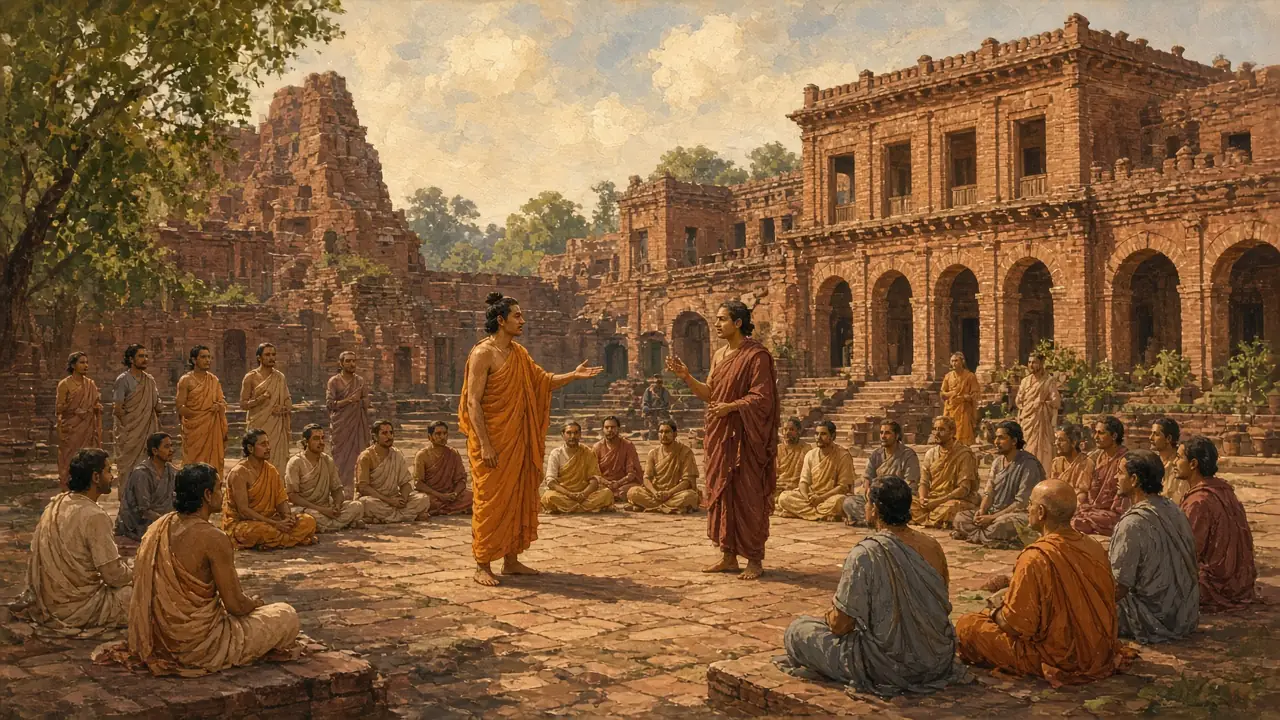
Non-Vedic traditions · c. 150 CE
Madhyamaka
Overview
Things exist by dependence, with no fixed nature of their own. The middle way avoids both eternalism and nihilism.
Madhyamaka, the school of the middle way, was founded by Nagarjuna around the second century CE. He argued that nothing has svabhava, an independent nature of its own. Things arise in dependence on causes, parts and the names we give them. That dependence is what he calls emptiness, which is not a void but the absence of a hidden core.
Read more (2 more paragraphs)
He separates two truths. On the everyday level, there are cups, rivers and persons, and they work as they do. On the ultimate level, none of them stands alone. The two are meant to be held together. Ignoring the everyday level makes us careless, and clinging to it makes us rigid. The middle way runs between eternalism, which treats things as fixed, and nihilism, which treats them as nothing.
Critics ask whether saying that everything is empty undermines the claim itself, and in his Vigrahavyavartani Nagarjuna replies that his own words are empty too, yet still do their work, as one conjured illusion can expose another, and that he puts forward no thesis of his own. Emptiness is not a new thing to grasp. The practical habit is to loosen fixed labels for yourself and others while still acting with care, since what you do is one of the conditions that shape what happens next.
Where it answers
What is real?
Nothing has a nature of its own. Things are real by depending on other things.
How do we know?
Every view depends on conditions; use everyday truths without mistaking them for the final word.
Key terms
- Sunyata
- Emptiness: things lack independent, self-standing existence.
- Svabhava
- Own-being: the independent essence that, Madhyamaka says, nothing has.
- Pratityasamutpada
- Dependent origination: everything arises through conditions.
- Two truths
- Conventional truth, how things work in daily life, and ultimate truth, their emptiness.
In their words
“Whatever is dependently co-arisen, that is explained to be emptiness.”
Further reading
- Mulamadhyamakakarika · Nagarjuna
- Bodhicaryavatara · Shantideva
Learn this
Related schools
Influenced by

Influenced

Disagrees with

In this tradition


Compare
Cite or share this page
A plain reference you can paste into notes or an essay:
Quest2Reason. “Madhyamaka.” https://quest2reason.com/learn/ideas/madhyamaka. Accessed 13 November 2026.